Development is multifaceted, but history makes one thing clear: jobs matter. Jobs are both a source of growth – economies thrive as opportunities are created for workers to contribute productively to them – and a means to escape poverty. This is the self-reinforcing pattern observed in all development success stories.
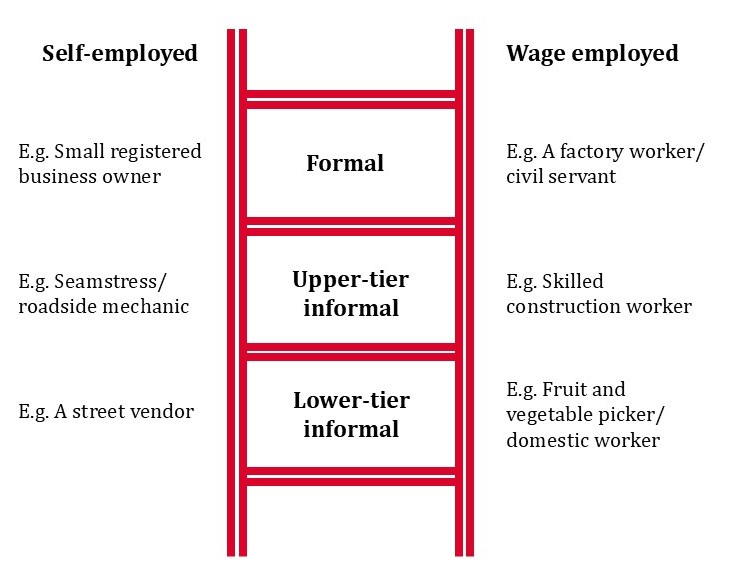
The idea of a ‘job ladder’ is a relatively recent addition to the literature on jobs and development, aiming to conceptualise the structure and dynamics of labour markets. Fields et al. (2023) present a framework of developing country labour markets in multiple tiers, with ‘formal’ jobs – those within legal and regulatory frameworks offering secure contracts, worker’s benefits, etc. – at the top. The distinction between formal and informal jobs, and the need for more of the former and less of the latter, is an old idea. Yet a job ladder offers a more nuanced lens by capturing the differences in job quality on the lower rungs, for example, between an unskilled street vendor and a skilled, but still informal, mechanic.
According to this thinking, the process of development through the ‘upgrading’ of jobs is akin to climbing the ladder for both waged and self-employed labour. Workers can, theoretically, haul themselves out of poverty by climbing the rungs, both within the informal sector and by transitioning into formal employment. A critical question for development is how much movement up the ladder there is. The immediate outcome of DFI investments is often job creation at the top of the ladder – we cannot directly invest in informal, unregulated businesses for obvious reasons. However, we also seek to create upward mobility for those on the lower rungs by investing in financial intermediaries that on-lend to informal businesses, or firms that indirectly create informal jobs through supply chains.
This blog explores the relevance of a job ladder for DFIs by looking at a recent UNU WIDER working paper by Ampaw et al. (2024), which uses labour force survey (LFS) microdata to examine job ladders in five countries where we invest: Ghana, India, South Africa, Tanzania, and Uganda.
What does the paper tell us?
Many of the primary findings are what we would expect. Climbing the ladder – characterised by the movement of a worker onto a higher rung as they are surveyed over different points in time – is linked to poverty reduction as wages tend to be higher on the higher rungs, though the strength of this link varies across countries.[1] Also, most of the workforce in the poorer countries in the sample are trapped at the bottom of the ladder in “lower-tier” informal employment: 57 per cent in Uganda, 56 per cent in Tanzania, and 54 per cent in Ghana. This is particularly true for women (two-thirds in Tanzania) and marginalised groups (72 per cent of “Scheduled Tribes” in India). So upward mobility on the job ladder contributes to poverty reduction, yet in labour markets where ‘good’ jobs are few and far between, the most disadvantaged workers are more likely to be trapped at the bottom. This suggests that investments that create more space on the higher rungs, and/or those that target a “leg up” to those at the bottom, can create upward mobility and therefore impact.
However, slipping down the ladder is roughly equally likely as climbing up across all countries in the sample. While some downward shifts are an inevitable part of the churn in any country’s labour market, a positive market-wide trajectory would be reflected by total climbs outweighing total falls. This is not the case in the countries studied here. Also relevant is the fact that upward movements typically happen in a single step, i.e. instances where workers at the bottom of the ladder leapfrog to the top are rare. This means that, in the countries and time periods studied, the most disadvantaged (and poorest) workers at the bottom of the ladder were unlikely to be hired directly into formal jobs. DFI’s impact-led targeting of businesses may create exceptions – see BII’s investment in iMerit as an example – which matters because reaching those most in need is likely to create greater impact (see BII’s ‘inclusive’ strategic objective).
The paper also finds evidence of a link between upward mobility and the nature of the businesses creating jobs. In Africa, the services sector is associated with higher upward mobility than agriculture or industry, suggesting growth in services in those countries over the period studied is creating more space for upward movers. The majority of upward movers in the sample are found in micro and small enterprises (MSEs, defined as less than 50 employees). Close to 80 per cent of upward moves occurred in MSEs in both South Africa and Tanzania. The paper also finds evidence that people in urban areas have greater upward mobility, reflecting how the countries that have experienced the greatest success in reducing poverty often saw private investment that generated growth in urban areas (Carter et al. 2024).
The macro matters
The challenge with interpreting what we are learning about job ladders is unpicking what we observe from the underlying macroeconomic conditions and drawing out implications for where DFIs should invest, if we want to help people move up the ladder.
Take China’s remarkable industrialisation and accompanying poverty reduction. If this job ladder analysis had been performed on China during that period, we might expect to have observed high volumes of people “double jumping” from the bottom rung into formal employment. Enormous growth in manufacturing meant that firms were forced to draw on the available pool of workers – mostly agricultural workers – and train them. Had we done that analysis, should we have concluded anything different about where DFIs should invest, than we should conclude from observing fewer “double jumps” in countries with lower economic growth and slack labour markets?
Suppose we observe an economy with little employment growth in formal firms, and so few people moving out of poverty by climbing to the top rung of the job ladder. Does this tell us that investing in formal firms is not the way to help people move out of poverty? No. More formal firms might be exactly what that economy needs, to become more like China. It is hard to see that we learn anything about the impact of investing in different types of firms from observing patterns of movement up and down the job ladder in different countries.
The fact that movements up the ladder within the informal sector (to the second rung) are important, and that people in the countries studied rarely seem to jump from the first to the third (top) rung, suggests the importance of creating more space on the second rung. But one of the possibilities that the analogy of a job “ladder” raises is that, if you want more people to move from the first to the second rung, there could be two ways of achieving it: one is by directly creating more space on the second rung, the other is by creating more space on the top rung, thereby indirectly creating more space on the second, as people there vacate it by moving up. The net benefit to society might be better in the latter case, because it ends up with more top rung jobs. The descriptive data in this paper cannot answer that sort of question.
There is also a subtler point: the poverty-reducing benefits of creating jobs on the high rungs of the ladder consist of more than the gains individuals experience when they get those jobs. Obviously, people earn different incomes in different jobs, in part because people have different abilities and labour market experience, but once you start thinking about the employment options facing individuals of a given level of ability and experience, there are market forces that can keep the gains from moving jobs relatively small. If the formal manufacturing sector is offering inexperienced workers say $10 per day, then people earning less than that in agriculture will leave to take those jobs, pulling up average earnings among those remaining in agriculture, who are earning enough not to want to work in a factory. Or seen from the other direction, if there is a large pool of rural workers earning $8 per day, then the wages that manufacturing businesses need to offer to attract and retain workers won’t be far above that. One can think of all sorts of reason why, in reality, wages do not continually adjust as workers move around, so that the gains from moving between jobs remain small.[2] But at the same time, we should not be surprised if we learn that, for example, taking a job in formal sector manufacturing only has modest effect, on average, on individuals’ income.
Again, this observation would not tell us that manufacturing is unimportant for poverty reduction, because although labour markets might be working to keep the gap between wage available to a given worker in different occupations relatively small, poverty is reduced as wages in all sectors rise together, over time. It could be that the manufacturing sector is the engine that drives that process, pulling up wages in the rest of the economy behind it. We want a rising tide that lifts all boats, even if the benefit of jumping ship is small.
We supported UNU WIDER’s jobs ladder research, because we want to know more about how people escape poverty through increasing their incomes in the labour market. We certainly want to know more about what moves people onto, and up, the jobs ladder. But there is not yet an obvious lesson for DFIs to draw from these results.
Economic growth and the resulting labour demand in growing areas of the economy are critical for an upwardly mobile job ladder. While DFIs do not have the power to singlehandedly generate tight labour markets with more upward mobility, we do have ability to target market failures and pioneer nascent industries that can contribute to economic dynamism.
Footnotes
[1] Intuitively, upward movements on the job ladder have a higher probability of enabling workers to escape poverty in countries where poverty rates are higher.
[2] There is a lot of good research into the gains associated with rural to urban migration – here is a recent example. An important point is that when workers have different abilities and have already sorted into the sectors where they are most productive, then the wage gaps between sectors are not necessarily a good guide to how much an individual would benefit from moving. However, there are many “frictions” in labour markets that mean wage gaps can remain high.